

Nylon 6 vs. Nylon 66: Which is Better for Swimwear?
May 29, 2026
Leave a message
What You're Actually Buying: Polymer-Level Differences
Both fibers are polyamides, but their molecular structure is not the same.
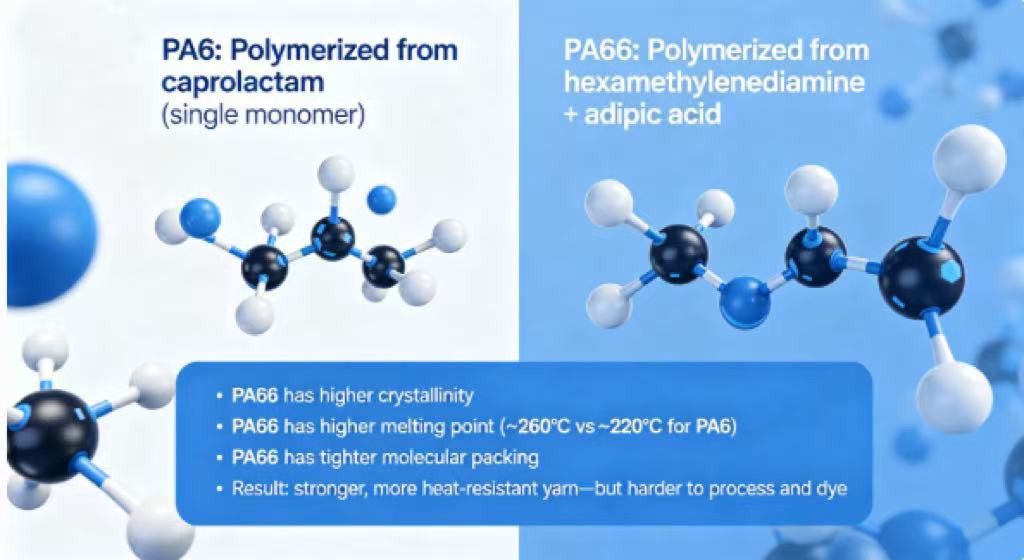
Nylon 6 (PA6): Polymerized from caprolactam (single monomer).
Nylon 66 (PA66): Polymerized from hexamethylenediamine + adipic acid.
This matters because:
PA66 has higher crystallinity
PA66 has higher melting point (~260°C vs ~220°C for PA6)
PA66 has tighter molecular packing
Result: stronger, more heat-resistant yarn-but harder to process and dye.
Fiber Performance That Impacts Your Production
1. Tensile Strength & Abrasion Resistance
Nylon 66 yarn is ~15–20% stronger than Nylon 6 at the same denier.
Better resistance to pilling and surface fuzzing.
Factory implication:
PA66 is preferred for high-end swimwear and performance lines.
Lower defect rate in seam stress testing.
2. Dyeing Behavior & Color Fastness
Nylon 6: more open structure → absorbs dye faster.
Nylon 66: denser → requires higher temperature + longer dye cycles.
Impact:
PA6 = lower dyeing cost, shorter Lead Time.
PA66 = better Color Fastness (Grade 4–4.5) after washing and UV exposure.
Risk point:
If your factory is not experienced with PA66, expect shade variation issues across batches.
3. Moisture Regain & Drying Speed
Nylon 6 absorbs slightly more moisture (~4% vs ~3%).
Both are low compared to cotton, but difference shows in finishing.
Implication:
PA66 dries marginally faster.
Less risk of post-dye shrinkage variance.
4. Heat Resistance & Finishing Stability
PA66 handles higher temperatures in:
Heat setting
Sublimation printing
Elastic bonding
Why this matters:
Cleaner shape retention after 50+ wash cycles
Lower shrinkage rate (<2%) when properly heat-set
Manufacturing Reality: Cost, MOQ, Lead Time
This is where most buyers make the wrong call.
Nylon 6 vs Nylon 66 – Factory Comparison Table
| Metric |
|
Nylon 66 (PA66) |
| Typical GSM Range | 160–240 GSM | 180–260 GSM |
| Cost Index (FOB) | 1.0 (baseline) | 1.15–1.30 |
| Yarn Cost | Lower | Higher |
| Dyeing Cost | Lower | Higher |
| Durability | Good | Excellent |
| Color Fastness | Grade 3.5–4 | Grade 4–4.5 |
| Shrinkage Rate | 2–3% | <2% |
| MOQ (Fabric Mill) | 300–500 kg | 500–800 kg |
| Lead Time | 20–25 days | 25–35 days |
Sourcing Strategy: When to Use Nylon 6
Use PA6 when:
You are running fast-fashion swimwear
MOQ needs to stay flexible
You need short Lead Time
Price sensitivity is high (mass retail)
Typical use cases:
Promotional swimwear
Seasonal prints
Entry-level private label
Watch out for:
Lower abrasion resistance → higher return rate after heavy use
Color fading under chlorine and UV
Sourcing Strategy: When to Use Nylon 66
Use PA66 when:
You're building a premium or performance brand
You need long lifecycle garments
Your positioning includes durability claims
Typical use cases:
Competitive swimwear
Premium bikini lines
Long-wear resort collections
Factory advantage:
Easier to pass AQL 2.5 inspection for:
Fabric defects
Seam breakage
Color consistency after washing tests
Blended Reality: Most Swimwear Is Not 100% Nylon
Let's be direct. Neither PA6 nor PA66 is used alone in modern swimwear.
Standard composition:
80–90% Nylon (PA6 or PA66)
10–20% Elastane (Spandex)
What matters more:
Yarn quality (FDY vs DTY)
Knitting structure (warp knit > circular knit for swimwear)
Finishing process
You can specify PA66 and still get poor results if:
Heat setting is inconsistent
Elastane quality is low
Dye house lacks experience
Quality Control Checklist (What We Check Before Shipment)
For both PA6 and PA66 programs:
GSM tolerance: ±5%
Color Fastness: Wash, chlorine, UV (ISO standards)
Shrinkage rate: <3% after 5 washes
Fabric recovery test: stretch cycles
Pilling resistance: Martindale >20,000 cycles
AQL 2.5 inspection: full garment
For PA66 specifically:
Dye lot consistency across rolls
Heat-set stability at higher temps
The Real Decision: It's Not Just Material
Here's the blunt answer:
Nylon 6 is easier to buy
Nylon 66 is harder to execute well
If your supplier lacks:
Advanced dyeing control
Stable yarn sourcing
Technical finishing capability
Then PA66 will create more problems than value.
Final Recommendation from the Factory Floor
Start with Nylon 6 if you're testing a new market.
Move to Nylon 66 when:
Your order volume stabilizes
Your brand positioning supports higher FOB
You need durability as a selling point
The wrong material won't kill your product.
The wrong factory handling the material will.